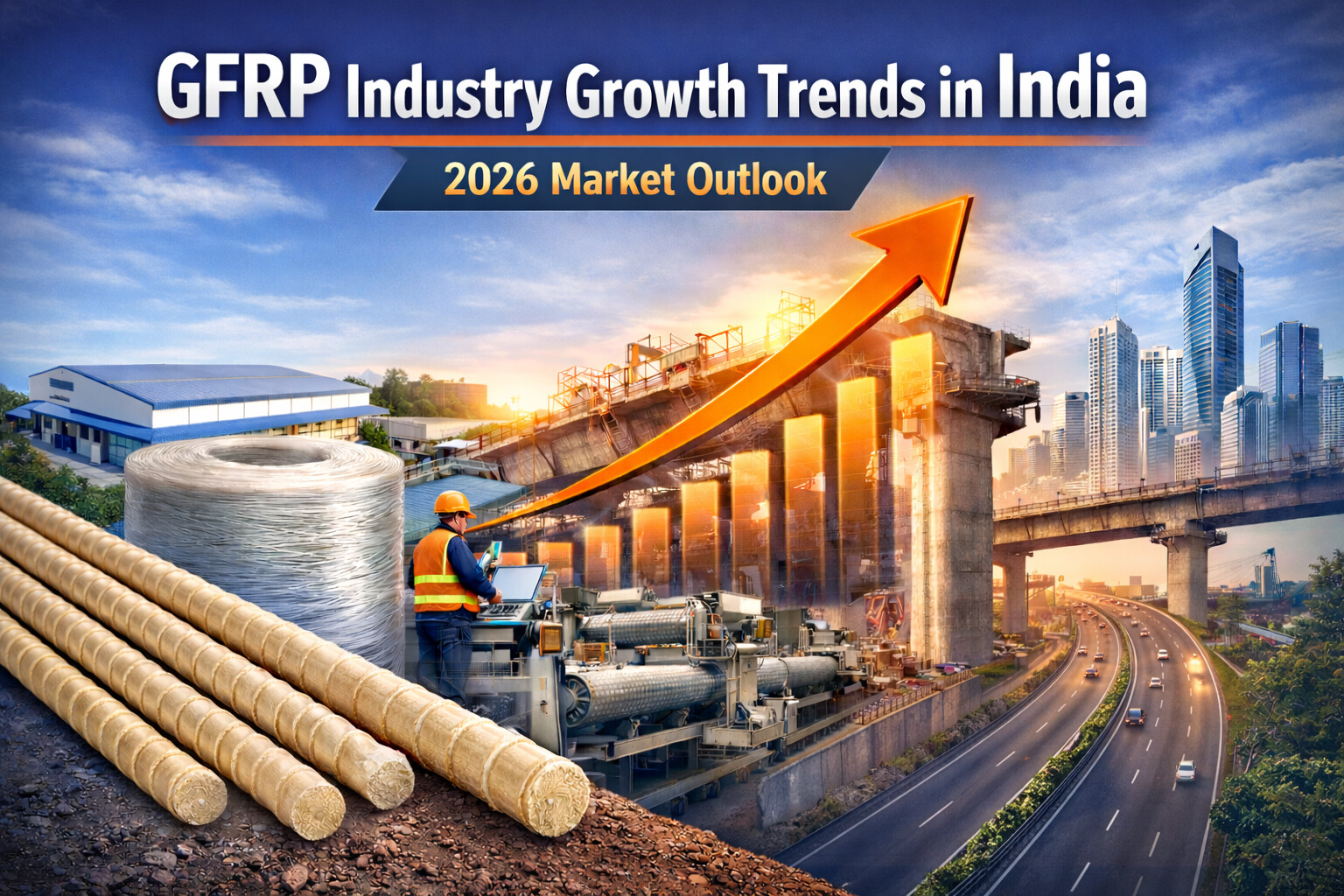
“GFRP Industry Growth Trends in India: 2026 Market Outlook”
Glass Fiber Reinforced Polymer (GFRP) materials are increasingly becoming a cornerstone of modern manufacturing and infrastructure in India. From infrastructure projects to renewable energy and automotive applications, the GFRP industry is poised for major growth through 2026 and beyond. This blog explores the latest trends, forecast data, key drivers, challenges, and what businesses should expect in the Indian GFRP market.

What is GFRP and Why It Matters
GFRP is a composite material made by reinforcing a polymer matrix with glass fibers. It offers high strength-to-weight ratio, corrosion resistance, durability, and low maintenance costs compared to traditional materials like steel and aluminum. These advantages make GFRP ideal for reinforcement bars (rebars), infrastructure components, automotive parts, and renewable energy products such as wind turbine blades.
📊 Indian GFRP Market Outlook to 2026
Market Growth and Forecast
The global GFRP market is expected to grow significantly in the coming years — with estimates projecting overall market expansion from approximately USD 71.17 billion in 2025 to around USD 74.61 billion in 2026, and further to USD 94.47 billion by 2031 at a CAGR of ~4.8% globally. Asia-Pacific, including India, is among the fastest-growing regions due to rapid infrastructure development and industrial growth.
In India specifically:
- The composite rebar market, where GFRP is the largest segment, is forecast to grow from about USD 20.1 million in 2024 to USD 29.4 million by 2030 at a CAGR of 6.6%.
- Other analyses highlight that the overall GFRP composites market will continue expanding as more industries adopt corrosion-resistant and lightweight materials.
With these trends, India’s demand for both GFRP products and GFRP production/manufacturing capacity is expected to accelerate through 2026.
🌍 Key Trends Driving GFRP Growth in India
1. Infrastructure & Construction Boom
Rapid urbanisation and deep investments in ports, highways, metros, bridges, and coastal infrastructure are boosting demand for GFRP rebars and other composite products. GFRP’s corrosion resistance and low lifecycle costs make it attractive for marine and high-moisture environments, where steel reinforcement would deteriorate faster.
2. Government Standards and Adoption
Industry standards like the BIS specification for GFRP bars (e.g., IS 18256:2023) are helping build confidence among engineers and builders, encouraging adoption in concrete reinforcement and structural applications.
3. Advanced Manufacturing Technologies
Manufacturers are embracing automated pultrusion, resin transfer moulding, and other advanced processes that allow higher production precision, faster throughput, and better product quality. These technologies are critical for scaling GFRP manufacturing facilities and reducing unit costs.
4. Renewable Energy & Automotive Trends
GFRP’s lightweight and high-strength properties are increasingly utilised in wind turbine blades and automotive components — especially as the transportation industry transitions toward lightweight structures and electric vehicles.
5. Sustainability and Circular Economy Push
Eco-friendly materials and sustainable manufacturing practices are gaining traction globally and in India. Innovations such as recyclable resins and bio-based composites are driving both environmental appeal and regulatory acceptance.
🚧 Challenges Facing the GFRP Industry
While the outlook is strong, the GFRP sector in India still faces some hurdles:
Higher Production Costs
GFRP raw materials like glass fibers and advanced resins are capital-intensive and can fluctuate in price. Initial production costs can be higher than traditional materials — although lifecycle savings often offset this.
Recycling and End-of-Life Issues
Recycling GFRP products poses challenges because separating glass fibers from resin matrices is difficult and costly, limiting circular economy benefits.
Skill Gaps in Manufacturing
Advanced composite manufacturing requires specialised skills and technical knowledge. Addressing workforce development and training needs will be crucial to scaling production quality and capacity.
📈 What This Means for Indian Manufacturers
For companies involved in GFRP production and manufacturing in India, this growth phase presents strategic opportunities:
✔ Expand production capacity with advanced manufacturing lines.✔ Invest in R&D to innovate eco-friendly and cost-efficient materials.✔ Focus on applications with fastest adoption rates — such as infrastructure, transportation, and renewables.✔ Improve digital marketing and SEO around high-value keywords like GFRP manufacturing, GFRP production India, and GFRP industry trends to capture visibility among engineers and procurement professionals.
📌 Final Takeaway
The GFRP industry in India is on a positive growth trajectory through 2026 and beyond, led by infrastructure investment, evolving standards, innovative manufacturing, and sustainability trends. While challenges remain, the increasing need for corrosion-resistant, lightweight composites across sectors presents a strong opportunity for manufacturers, suppliers and industry stakeholders
More Blogs
.svg)
Frequently Asked Questions

Still have questions? We're here for you! Whether it's about performance, pricing, or project suitability — our team is ready to assist.