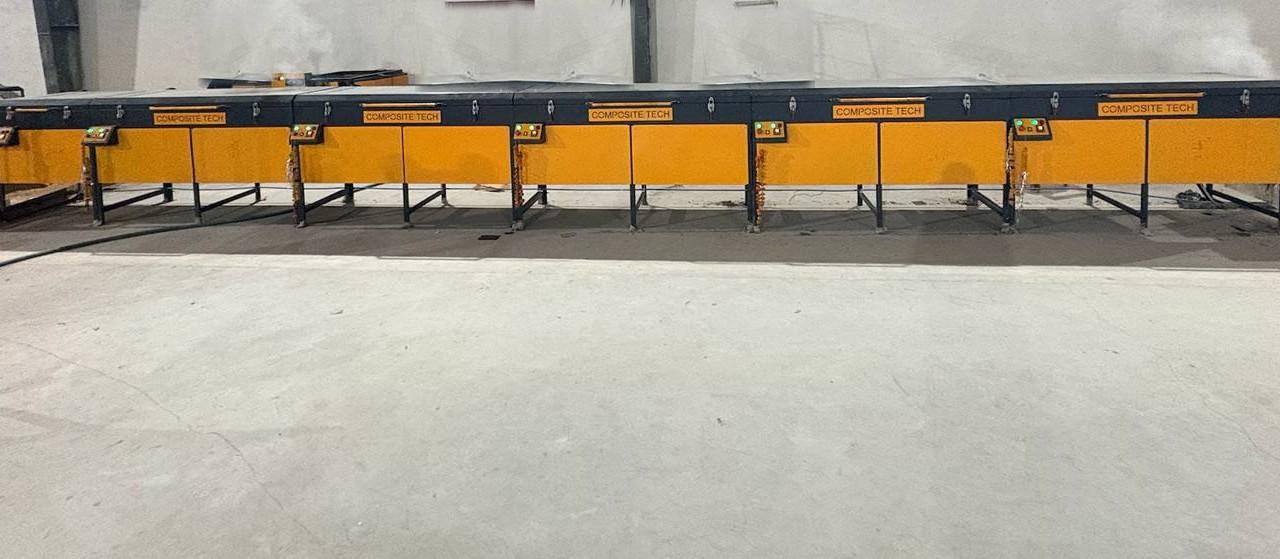
Setting up a GFRP rebar manufacturing plant in India requires evaluating full project capitalization rather than the purchase price of a pultrusion machine alone. Project reports distributed by equipment brokers frequently claim a composite rebar unit can be commissioned for ₹25 to ₹35 lakh. That budget only buys an uninsulated, low-speed two-strand machine without auxiliary infrastructure or testing instruments. A commercially viable plant producing structural composite reinforcement that complies with IS 18256:2023 requires between ₹1.35 crore and ₹1.65 crore in total capital outlay. Understanding where this capital is allocated prevents liquidity shortages during plant commissioning.
Machinery capital expenditure: strand count and automation
The production line constitutes the primary capital investment. An industrial multi-strand line, configured to pull 4 to 6 strands simultaneously across 6 mm to 16 mm diameters, costs between ₹75 lakh and ₹85 lakh. This includes a multi-tier roving creel with individual tension brakes, a temperature-regulated resin impregnation tank, multi-zone heating dies capable of holding 250 °C, synchronized helical ribbing units, a continuous servo caterpillar puller, and an automated flying cut-off saw.
A budget two-strand machine for ₹20 lakh restricts production output to 20 to 25 kg per hour. An industrial multi-strand line delivers 120 to 180 kg per hour with the same floor crew. Because shed rent, supervision, and administrative overheads are fixed, the multi-strand setup drops conversion cost from ₹40 per kg on small machines down to ₹12 to ₹15 per kg.
Factory shed dimensions and electrical infrastructure
GFRP pultrusion is a continuous linear process. The machinery requires a minimum unobstructed linear length of 32 metres: 6 metres for creel feed, 3 metres for impregnation, 8 metres for dies and heating tunnel, 4 metres for the caterpillar puller, 4 metres for the cutting stroke, and 7 metres for inspection and coiling. Storing roving pallets, resin drums, and finished coils requires a covered shed of 4,000 to 6,000 square feet.
Industrial shed rent in manufacturing hubs like Pithampur or Sanand ranges from ₹15 to ₹22 per square foot, or ₹70,000 to ₹1,10,000 monthly. Power infrastructure requires an industrial connection with 60 to 80 kVA sanctioned load. Transformer installation, main panels, and cabling require ₹7 to ₹10 lakh. Die heating draws 18 to 28 kW during steady-state production. Insulated dies operate at 0.7 to 0.9 kWh per kg, whereas uninsulated dies draw 2.0 to 2.4 kWh per kg, adding ₹15 lakh in annual electrical waste at ₹9 per unit.
Mandatory in-house laboratory for IS 18256:2023 compliance
To supply infrastructure projects or highway work, a plant must secure a Bureau of Indian Standards license under IS 18256:2023. Grant of the CM/L certificate requires an operational factory testing laboratory before the preliminary audit. Equipping this internal quality control lab requires ₹10 to ₹14 lakh.
The mandatory lab setup includes a muffle furnace operating to 600 °C to determine fibre content by resin burnout, a digital analytical balance with 0.1 mg accuracy, dial calipers for nominal cross-sectional area measurement, a water bath for moisture absorption, and transverse shear test fixtures. Routine factory production control requires continuous internal verification of resin cure and fibre mass fraction.
Working capital and raw material buffer
Direct-draw E-CR glass rovings (2,400 to 4,800 tex) cost ₹78 to ₹80 per kg delivered with GST. Structural epoxy resin systems (resin base, hardener, and accelerator) cost ₹240 to ₹280 per kg. At an 80:20 glass-to-resin ratio, unworked raw material input cost sits between ₹104 and ₹108 per kg.
Producing 30 tonnes per month requires 24 tonnes of glass roving and 6 tonnes of formulated resin on site. Suppliers operate on advance payment or 14-day terms, while infrastructure buyers typically take 30 to 45 days of credit. Maintaining a 30-day raw material stock alongside receivables requires ₹35 lakh to ₹45 lakh in liquid working capital.
Total investment and commercial break-even
Aggregating machinery (₹80 lakh), electrical setup (₹8 lakh), laboratory apparatus (₹12 lakh), shed lease deposit (₹3 lakh), and working capital (₹40 lakh) establishes an initial capital requirement of ₹1.43 crore. Attempting to start below ₹1.2 crore forces compromises on die heating, puller synchronization, or resin quality, causing failures during third-party durability checks. With conversion costs held at ₹14 per kg on an industrial multi-strand line, an operating volume of 35 to 50 tonnes per month achieves commercial break-even within 14 to 18 months of commissioning.