Straight rebar · two barsThe entry line. Smallest footprint of the three and the usual starting point for a plant running one or two diameters.
2Bars at once
3–20 mmDiameter range
3-phaseSupply
CaterpillarPuller type
Straight rebar · four barsThe common choice. Enough line for a plant selling into private work with room to take a bigger order.
4Bars at once
3–20 mmDiameter range
31.5 × 5.2 × 2.5 mFootprint L×W×H
CaterpillarPuller type
Straight rebar · six barsWhat we run at Pithampur. Same footprint as the CT4, more bars through it.
6Bars at once
3–20 mmDiameter range
35 kWConnected power
380 V3-phase supply
Bent elementsStirrups and shaped elements, cut and bent to drawing. Different economics from straight bar, usually better.
6–16 mmDiameter range
CNCBending control
ProgrammableShape memory
Separate lineNot an attachment
MeshWelded GFRP mesh for slabs and surface beds.
1 or 2Mesh widths
ProgrammableGrid spacing
Roll or sheetOutput form
Separate lineNot an attachment
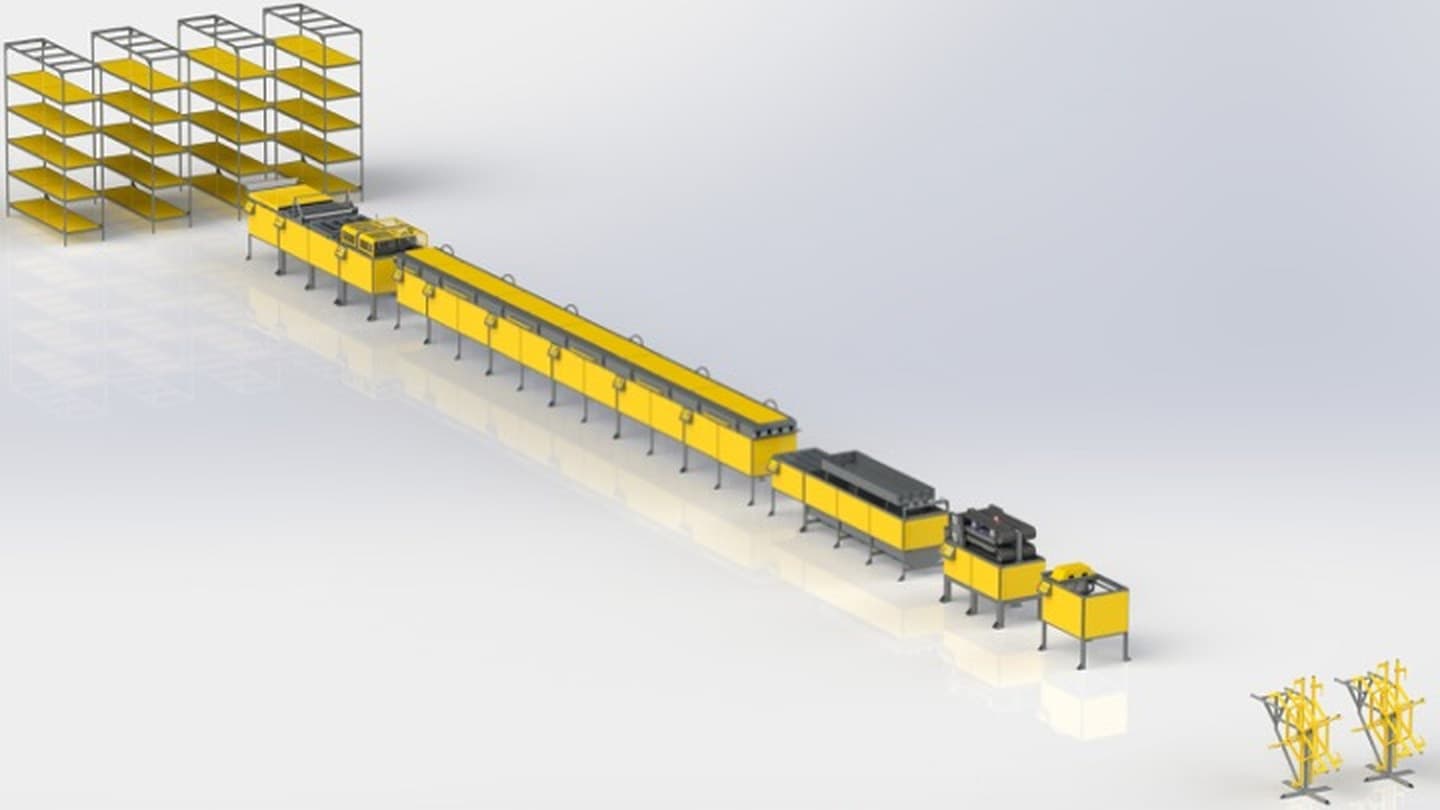
Inside the line
Eight stations in a row. Each one can spoil what the one before it did, which is why a four-hour run tells you more than a specification sheet.
01CreelRoving feeds from the back of the line. How evenly it feeds decides whether the bar has a consistent section.
02Pre-heat and plasmaRoving is dried and surface-activated before it meets resin. Bond between fibre and matrix is won or lost here.
03Three-stage impregnationResin introduced in stages rather than one bath. Dry fibre inside a bar is a void, and voids are where attack starts.
04Wrap and surfaceHelical wrap and sand coating applied before cure. Retrofitting this later is expensive.
05SWIR curingShort-wave infrared passes through the glass and is absorbed by the resin, so the bar cures from the inside out.
06Two-stage coolingControlled air, then water. Cooling too fast locks stress into the bar.
07Caterpillar pullerGrips along a length rather than at points. This is what holds modulus where a roller puller does not.
08Cut or coilTo length, or wound. Cut length consistency is measured here.
The lines also run basalt and carbon fibre, and epoxy, vinyl ester or polyester resin systems.