When planning a new manufacturing plant for GFRP rebar, bent bar elements, or reinforcing mesh in India, the most tempting quote is often a low-cost single or double-strand machine. The initial purchase invoice looks easy to fund, the supplier promises standard production across 8 mm to 16 mm bars, and the low entry ticket makes the venture look low risk. Once the machinery lands on the factory floor, the economics reverse. What was bought to conserve capital turns into a continuous drain on working capital, because composite manufacturing profitability is decided by conversion cost, power efficiency, and line continuity rather than the sticker price of the equipment.
Conversion cost and market competitiveness
Raw materials cost essentially the same for every manufacturer across India. Direct-draw E-CR glass rovings and vinyl ester or epoxy resin systems trade within narrow price bands. Because raw materials make up 65 to 75 percent of the total cost of a compliant bar, gross margins depend entirely on the conversion cost per kilogram: labor, power, shed space, and interest spread over actual output.
A low-cost twin-strand line pulling at 0.7 metres per minute yields roughly 20 to 25 kilograms of 12 mm rebar per hour. Because factory shed rent, security, supervisory staff, and plant overheads remain fixed regardless of output, the conversion cost on that slow line easily exceeds ₹35 to ₹45 per kilogram. A multi-strand industrial line running four to six bars simultaneously at 1.4 to 1.8 metres per minute outputs 120 to 180 kg per hour with the same floor crew. Its conversion cost drops to ₹12 to ₹16 per kilogram. When bidding for infrastructure tenders, highway crash barriers, or precast elements where decisions turn on ₹2 to ₹4 per kilogram, the operator running a cheap line is priced out before submitting a commercial proposal.
The compliance gap: why cheap dies fail IS 18256:2023
India's standard for composite reinforcement, IS 18256:2023, is not satisfied by a bar that merely looks straight and ribbed. The specification mandates strict mechanical benchmarks: minimum tensile strength exceeding 1,000 MPa, a tensile modulus of at least 50 GPa, transverse shear strength above 150 MPa, and alkali resistance retention above 80 percent after exposure to high-pH alkaline solution at 60 degrees Celsius.
Budget machines routinely fail third-party lab testing because of compromised thermal control and resin impregnation. Curing pultruded composites requires distinct, multi-stage temperature zones across the die to regulate resin viscosity, handle the exothermic peak, and prevent thermal shock. Low-cost machines frequently use generic band heaters with basic controllers, generating hot spots and cold pockets. The resulting bar leaves the die with an under-cured core (degree of cure below 85 percent) or surface micro-cracks that allow alkaline concrete water to attack the glass filaments. Because composite scrap cannot be melted down and re-rolled like steel scrap, non-compliant batches are a total write-off.
Specific power consumption: the hidden electricity drain
Electrical power is one of the highest variable operating costs in a composite plant, typically running at ₹8 to ₹10 per unit (kWh) on industrial HT connections in states like Madhya Pradesh, Gujarat, and Maharashtra. The critical metric is specific power consumption: total kilowatt-hours drawn divided by kilograms of sellable product delivered.
Cheaper machines suffer from poor thermal insulation and inefficient mechanical drives. Uninsulated steel dies radiate heat into the shop floor rather than directing energy into the composite profile, forcing heaters to run continuously. Furthermore, basic pullers rely on undersized hydraulic power packs that run constantly under pressure relief, generating waste heat and drawing continuous base load. Modern high-specification lines use vacuum-insulated ceramic heating tunnels and closed-loop servo caterpillar pullers that draw power strictly in proportion to mechanical pulling load. Over a 300-tonne annual production run, an inefficient machine drawing 2.0 to 2.4 kWh per kg burns an extra ₹15 to ₹25 lakh in excess electricity compared to an engineered line operating at 0.7 to 0.9 kWh per kg.
Continuity, downtime, and operational uptime
Pultrusion is an uninterrupted chemical process governed by resin pot life and gelation curves. Unlike metalworking machinery, a pultrusion line cannot be paused casually for 15 minutes. If a line stops while wet glass sits inside a heated die, the resin crosslinks into an immovable solid plug within minutes. Clearing that die requires cooling the heaters, burning or drilling out the hardened composite, polishing the die bore, and re-threading 40 to 80 roving ends from the creel through every guide and tensioner.
On budget machinery, stoppages are frequent. Soft die coatings score easily under the abrasive action of glass roving, pulling pads slip under fluctuating pneumatic pressure, and uncalibrated ribbing heads break winding yarn mid-run. An eight-hour shift on an unstable line frequently yields only three to four hours of actual pulling time, dropping overall equipment effectiveness below 50 percent. Industrial lines built with hardened chrome carbide dies, precision ceramic roving guides, and automated flying cut-off units achieve sustained uptimes above 90 percent, converting shifts into predictable output.
Expanding to bent elements and reinforcing mesh
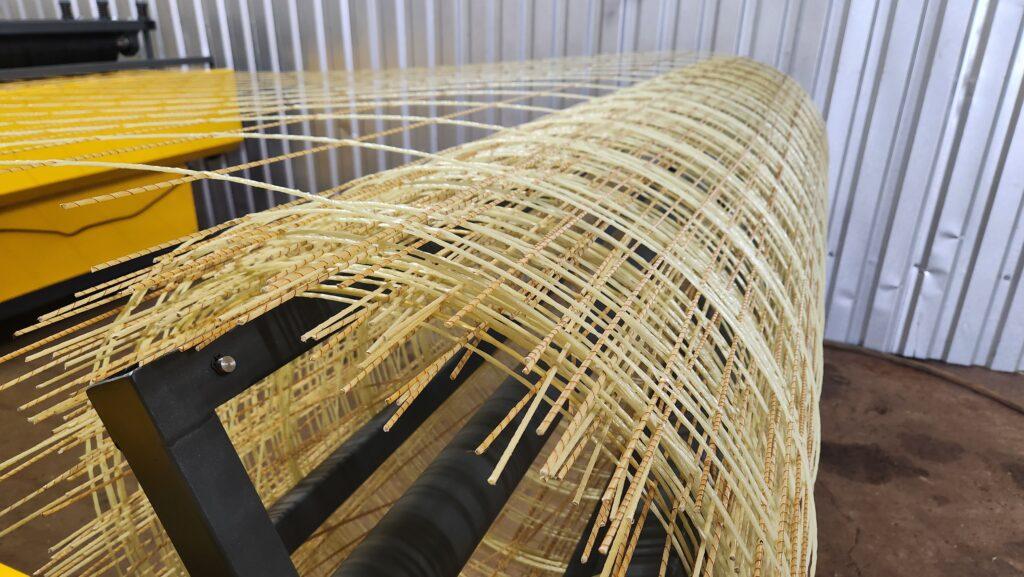
The cost penalty of cut-corner machinery becomes even more pronounced when expanding beyond straight rebars into factory-formed bent elements and reinforcing mesh. Bent bars, links, and shear stirrups cannot be bent on site; they must be formed and cured in dedicated jigs before resin gelation. Similarly, composite reinforcing mesh requires synchronized cross-wire feeding, automated thermal bonding, and continuous indexing across wide working widths.
A factory equipped with an engineered production line can reliably serve complete structural project schedules, supplying straight rebars, custom stirrups, and mesh panels that pass rigorous site audits. Attempting to manufacture structural mesh or bent elements on makeshift hardware yields inconsistent node bonding and erratic bar spacing that fail site inspections. In composite manufacturing, the capital saved on a cheap initial quotation is invariably repaid several times over in power bills, scrap material, and lost customers.